




Gr5 Titanium Square Disc vs Steel: Which Is Best for Industry?


 2026-11-20 13:20:03
A steel or Gr5 titanium square disc is what you're looking for. The job will tell you the right answer. The weight of a Gr5 titanium square disc made of Ti-6Al-4V is roughly half that of steel, it is resistant to seawater and chlorides, and it can withstand repeated stress. It is easier to work with steel, it gets stiffer, and it costs less.
Ti is a good metal to use when weight, corrosion resistance, or fatigue life are important to the design. When cost, stiffness, and wear resistance are the most important things, steel is the best choice. This article talks about the specs and where the materials come from of the two materials and gives buyers a list of things they should check before the order is placed.
|
|
|
Gr5 Titanium Square Disc vs Steel: Key Differences at a Glance
Why No Single Material Wins
You should think about how the material will be used before you look at the price list. Steel is a big group of metals. Carbon steel, alloy steel, and 304 or 316 stainless steel all have very different prices, strengths, and resistance to corrosion. This is Grade 5, also called Ti-6Al-4V. It is an alloy whose properties are more stable and easy to guess.
So, the real question is: Which property limits your design: stiffness, cost, weight, corrosion, or load? Buyers in the medical, aerospace, marine, and chemical processing industries often give different answers than buyers of general machinery. Make a list of your load, environment, production volume, and compliance needs before you compare quotes.
Weight and Strength-to-Weight Ratio
Ti-6Al-4V has a density of 4.43 g/cm³. Titanium weighs 7.85 g/cm³ less than steel for the same size piece. Annealed Grade 5 plate must have 895 MPa tensile and 828 MPa yield strengths, per ASTM B265. Annealed 304 stainless steel yields at least 205 MPa. Because of this, titanium is stronger per unit weight than most stainless steels. Heat can manufacture alloy steels as strong as this one but roughly twice as heavy. This space is crucial for moving, turning, or hand-held pieces.
Stiffness, Machinability, and Cost
Iron isn't rigid like steel. About 200 GPa of elasticity, compared to 114 GPa in Grade 5. Titanium discs flex more when form and load match. Steel requires less labour. Titanium's low heat transfer (7 W/m·K compared. 50 W/m·K for carbon steel) keeps heat in place. Non-magnetic Grade 5 is suitable for delicate items. However, iron is not magnetic. It costs more to acquire and work with this metal. People will only pay more if the increased weight, corrosion resistance, or fatigue resistance pays off.
Gr5 Titanium Square Disc Properties and Chemical Composition
What a Square Disc Is
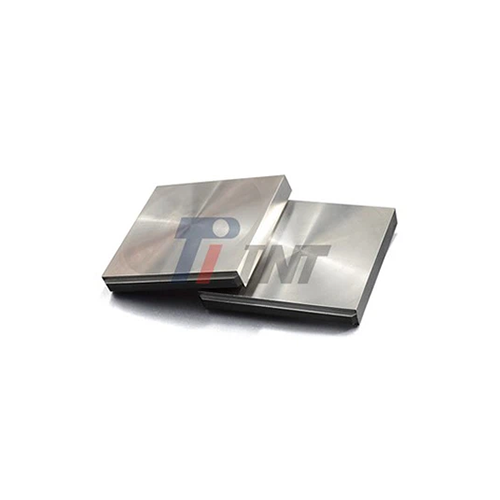
Flat, four-sided Ti-6Al-4V plate, sheet or bar stock is called a Gr5 titanium square disc. A hot roll, forge, laser cut, or CNC machine may make it. Each method has distinct cost, grain structure, and tolerance. Gr5 titanium square disc from 2 to 50 mm thick and any size are available from Baoji INT Medical Titanium Co., Ltd. These blanks are carved into needed sections. For an oval form, start with a square blank rather than a round bar. We sell just raw titanium, not completed parts.
Chemical Composition and Standards
5.5% to 6.75% of Grade 5 is aluminium, 4.5% to 4.5 % vanadium, and the remainder titanium. If it has more than 0.20 percent oxygen, the metal fractures quickly. The aerospace plate standard is ASTM B265. Plate and sheet standards are ASTM B348. ASTM F136 requires surgical implants with Ti-6Al-4V ELI extra-low interstitial. Know each question's standard. Industrial Grade 5 and implant-grade ELI differ. Each lot shall have a heat number, chemical analysis, and EN 10204 3.1 certificate.
Mechanical Behavior by Condition
Things change because of conditions. If you anneal, roll, forge, or solution-treat and age metal, it changes how strong and flexible it is. In most cases, Grade 5 is between 30 and 36 HRC hard. It is strong and flexible at the same time because of its alpha-beta microstructure. It can handle being loaded and unloaded a lot of times, which is why designers in biology and space use it. When it comes to steel, you have more choices.
Different tasks can be done with soft carbon steel, hardened tool steel, or stainless steel that doesn't rust. Titanium has a lower modulus, which means that parts may need to be thicker to keep them from warping. There is more than one number that should be used, so engineers should check thickness, fatigue, wear, and strength all at the same time.
Corrosion, Temperature, and Industrial Fit
Corrosion Resistance Versus 304 and 316
It generates a thin, stable oxide coating that recovers rapidly from scratches. Grade 5 can tolerate saltwater, chlorides, and damaging acids due to its film. Dry, inside, or mild, 304 stainless steel works. Although grade 316 can take more chlorides, warm saltwater may corrode and break it. Titanium requires less maintenance and replacement in chemical and marine environments since these issues occur less frequently. If the part only meets dry air and a little water, stainless steel usually works and costs less.
Temperature Limits
Grade 5 is strong even at temperatures below 400°C, making it suitable in many circumstances. At 1660°C, it melts too hot to use. while oxygen gets to the surface while it's heated, alpha case forms. Use steels or nickel alloys that can withstand long-term heat near or beyond these limitations. Also watch for creep and temperature fluctuations. As long as it meets industrial heat and steam sterilisation criteria, Grade 5 works well.
Which Industries Favor Each Material
Grade 5 can be used to make parts for ships and spacecraft, for processing chemicals, for centrifuge rotors, and as raw materials for medical devices. Because it isn't very dense and lasts a long time when it gets worn down. For general machinery, structural parts, rough tools, and a lot of work that won't be corroded, steel is still the best choice. People who buy medicines need to be extra careful.
Make sure the program needs ASTM F136 materials, and request certificates and inspection records that can be kept track of. Our Gr5 titanium square disc are used by companies that make their own parts for back, neck, and orthopedic problems. Make sure the certification and traceability are right for the job before you compare prices.
Manufacturing, Specifications, and Machining
Forged, Rolled, Laser-Cut, or Machined
The process choice changes the cost, the properties, and the lead time. By hot rolling, plates and larger flat items are made, and by forging, parts that are heavily loaded can become more structurally stable. So that the metal has better mechanical properties, we hot roll and forge it. We then use ultrasonic testing to find flaws inside the metal. You can get a better finish on the outside and keep the right size by cold rolling.
With a laser, you can cut small batches and prototypes, but you might need to finish the edges and check the area that got hot. With CNC machining, you can make holes, grooves, and corner radiuses that are very close to each other. What is the condition of the material, how it will be made, what the edge needs to be, and what the inspection needs are?
Choosing Dimensions and Finish
Write dimensions as length, breadth, and thickness, such as 100 × 100 × 10 mm. Temperature, load, span, deflection limit, and fatigue should determine thickness, not stock size. You may choose sizes between 2 and 50 mm thick. Next, tell us what surface you want (mill, grind, polished), and we'll tell you whether it's achievable. Write down export packing requirements and flatness, squareness, roughness, burriness, or cornering limitations. Clear designs reduce samples and save time.
Machining Titanium Without Surprises
TiN is tougher than steel to work. Heat accumulates at the cutting edge when heat doesn't circulate. A tool that rubs or lingers on metal hardens and galls. A solid platform, sharp carbide tools, constant cutting conditions, plenty of coolant, and a chip removal method are essential. Firm feeds work well at modest rates. Having identical lots is also significant. When chemistry and hardness don't vary across batches, scrap decreases. We examine each manufacturing step for ISO 9001:2015 and ISO 13485:2016 quality.
Cost, Lead Time, and Supplier Selection
What Drives the Price
The price of the raw material, controlled processing, slower machining, the need for specialized tools, certification, inspection, and traceability are just a few of the factors that contribute to the higher cost of a Gr5 titanium square disc when compared to steel. You can also change the price by order amount and finish. Check the total cost of cut-to-size pieces, stock blanks, and custom-machined disks when they arrive at the port.
It includes freight, duties, inspection, and Incoterms in this price. Then, look at how much it cost to buy and how much it will be worth in the long run. It may be worth the extra money up front if it means less weight, fewer repairs because of corrosion, and a longer service life.
Samples, Quantities, and Lead Time
A lot of work makes it hard to start new projects. Before you ask a supplier if they will take small test orders of different sizes, find out how long it takes to make samples, how long it takes to make the whole order, how long it takes to inspect, how it will be shipped, and if you can send parts of the order. Tests like metallography, chemistry, and mechanical checks are often sent to a separate lab.
It might take two to four weeks to finish this. Include that step in your plan. Also, make sure you reorder the same things every time, because a stopped line costs more than a price difference. When we give a quote, we talk to each customer about how much they want and when they need it.
Qualifying a Supplier
Check quality processes, heat traceability, chemical and mechanical reports, certifications, and measurements. For nearly 30 years, Zhan Wenge has been in the titanium industry. EU CE, ISO 13485:2016, and ISO 9001:2015 authorise our goods. When assessing a Chinese manufacturer, inspect their manufacturing and trade space. Get customer references, how to resolve issues, and evidence that they have dealt with regulated sectors before placing your first transaction. Video or in-person audits are also recommended.
Conclusion
A Gr5 titanium square disc is needed for various jobs. Steel weighs about 45% more than Grade 5 Ti-6Al-4V. This thing can handle heat up to 400°C, salt water, and chlorides, and it still works well after being loaded many times. For general machinery, rough tools, and high-volume work, steel is a good choice because it doesn't cost as much, gets stiffer faster, and is easier to machine.
There are chemistry, standards like ASTM B265 and ASTM F136, and certificates that can be tracked that tell you if a disk is right for the job. This is especially true in medical work. Cost and yield depend on how the product is made, how big it is, and how it is controlled. The best choice isn't based on price alone; it's based on the total cost of ownership, which includes price, weight, maintenance, replacement, and compliance.
FAQ
Is Grade 5 titanium stronger than steel?
Yes, for every pound of weight. At 4.43 g/cm³ and 895 MPa, it can pull apart at least Grade 5. Some steels that have been heated are just as strong, but they weigh almost twice as much.
Does Grade 5 resist corrosion better than stainless steel?
The answer is yes, because its oxide film stays stable in chloride and seawater. 304 stainless steel is usually enough when used inside and in dry conditions.
Can I order custom sizes?
Yes. Between 2 mm and 50 mm thick, the sizes can be changed. What is the finish and what are the tolerances?
What do you need for a quotation?
Send the grade, standard, size, quantity, yearly need, production route, use, place of delivery, inspection requirements, and target lead time.
Request a Quote for Gr5 Titanium Square Disc From Baoji INT
Are you looking for a Gr5 titanium square disc manufacturer? Sizes can be changed at Baoji INT Medical Titanium Co., Ltd., and thicknesses range from 2 mm to 50 mm. They are certified by ISO 9001:2015, ISO 13485:2016, and EU CE. Feel free to email export@tiint.com with your measurements, quantity, standard, and delivery date so that we can give you technical help, samples, and prices. Visit inttitanium.com to find out more.
References
1. ASTM International, ASTM B265 Standard Specification for Titanium and Titanium Alloy Strip, Sheet, and Plate, 2020.
2. ASTM International, ASTM F136 Standard Specification for Wrought Titanium-6Aluminum-4Vanadium ELI Alloy for Surgical Implant Applications, 2013.
3. ASM International, Materials Properties Handbook: Titanium Alloys, 1994.
4. ASM International, Titanium: A Technical Guide, 2000.
5. Wiley-VCH, Titanium and Titanium Alloys: Fundamentals and Applications, 2003.
6. Journal of Materials Processing Technology, Titanium Alloys and Their Machinability—A Review, 1997.