




Titanium Bar Surgery vs Plates: Which Implant Fits Your OEM?


 2026-10-12 15:59:39
When evaluating raw material sourcing for orthopedic implants, the choice between titanium bar surgery applications and plate-based fixation systems carries significant downstream consequences. Titanium bars — typically manufactured from Ti-6Al-4V ELI (ASTM F136 / ISO 5832-3) — serve as the primary blank material for intramedullary nail systems, where linearity tolerance and batch consistency are non-negotiable. Titanium plates, by contrast, draw on commercially pure grades or Ti-6Al-4V for load-sharing osteosynthesis constructs. Understanding both formats at the material level helps OEM procurement teams select the right titanium feedstock before a single CNC pass is made.
|
|
|
Understanding Titanium Bar and Plate Implant Materials
What Defines a Surgical Titanium Bar?
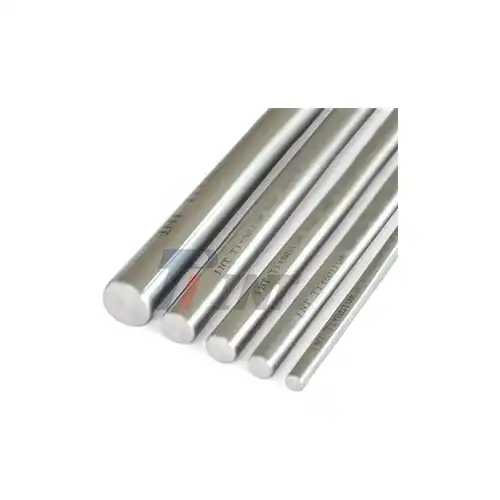
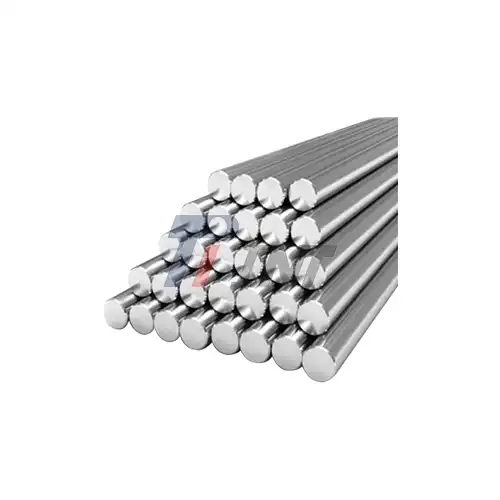
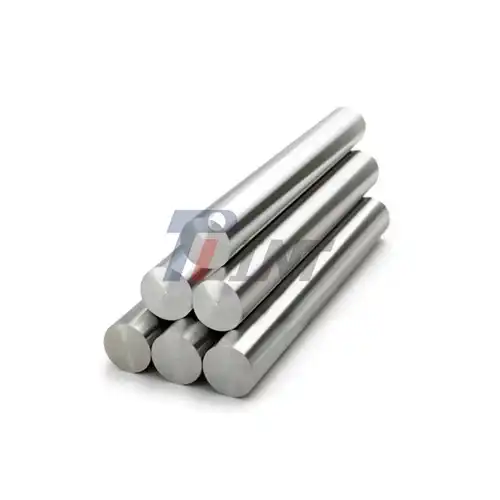
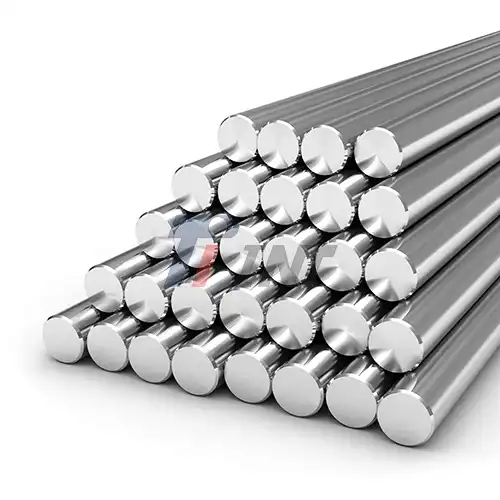
A titanium bar used to make surgical implants is a round or hexagonal billet that has been carefully drawn to very tight size standards (usually ±0.05 mm on diameter) and has straightness variations of less than 1 mm per meter. If you start with these bars as a blank, you can machine intramedullary nails, pedicle screws, and chest wall correction hardware. The standard material is usually ASTM F136 (Ti-6Al-4V ELI), which limits the amount of oxygen in the material to 0.13 weight percent to make it more resistant to fatigue in implant environments that are loaded and unloaded many times.
What Defines a Surgical Titanium Plate?
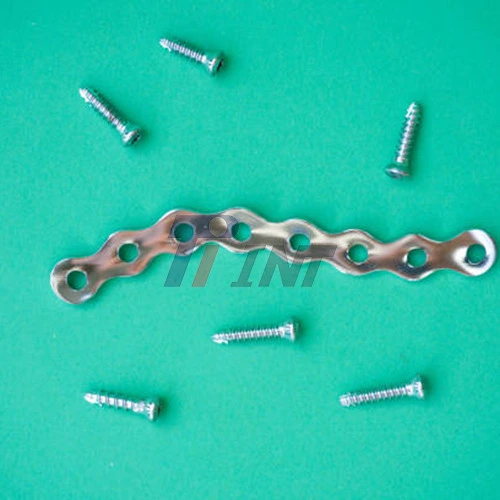
Titanium plates used in surgery are made from rolled sheet or forged slab, which is then carefully milled into locking compression plates (LCP), reconstruction plates, or craniofacial meshes. Grade 2 commercially pure titanium is used most often in craniofacial applications because it can be cold-formed more easily. Ti-6Al-4V ELI is used for injuries and spine parts that need to have a tensile strength of at least 860 MPa. Bars and plates are both made from the same basic material. What makes them different is their shape, how they are processed, and what they are used for afterward.
A passive TiO₂ layer forms on both formats on its own, which stops ions from leaking into the tissue around the implant. This is one of the main benefits over alternatives made of cobalt-chrome or stainless steel. For OEM makers, this means less work for biocompatibility tests and an easier way to follow the rules under ISO 10993.
Clinical Comparison: Bars vs. Plates in Surgical Context
When orthopedic OEMs design around titanium bar surgery instead of plates, the clinical end-use is much more important than cost alone when it comes to material selection. Intramedullary nails made from titanium bars have to withstand axial and rotational loads along the whole length of long bones. This means they have to last more than 10 million cycles at normal stress levels before they break. Plates act as extramedullary scaffolds and carry bending and shear forces that are mainly concentrated at the screw interfaces.
Important clinical differences to keep in mind:
- Load pathway: Bars-derived intramedullary implants distribute stress through the medullary canal, reducing periosteal stripping and preserving cortical blood supply — a clinically documented advantage in tibial and femoral shaft fractures.
- MRI compatibility: Both titanium bars and plates are non-ferromagnetic, making all downstream implants MRI-safe — a regulatory advantage that stainless steel hardware cannot match.
- Infection risk profile: Titanium's low ion release rate correlates with reduced bacterial adhesion compared to cobalt-chrome alloys, supporting lower revision rates in long-term follow-up studies.
Bars-derived intramedullary implants spread stress through the medullary canal, which keeps the cortical blood supply open and reduces periosteal stripping. This has been shown to be clinically beneficial in tibial and femoral shaft fractures.
Technical and Performance Evaluation
Mechanical Properties That Matter to CNC Teams
As per ASTM F136, Ti-6Al-4V ELI bar stock has a minimum tensile strength of 860 MPa, a yield strength of 795 MPa, and an expansion of 10%. The cutting parameters your CNC team sets for intramedullary nail blanks are based on these numbers, so they are not just numbers. If the hardness difference between batches is more than ±5 HRC, the tool life has to be recalculated, and more scrap is made. Your shop floor will be safe from unexpected downtime if the mechanical features are the same across all heat lots.
Plate blanks made of titanium that are rolled to ASTM B265 standards or forged to AMS 4928 standards need their own ways to be tracked, especially when titanium bar surgery demands full traceability from mill to implant. Finally, for both FDA 510(k) and EU MDR submissions, the audit loop is closed with a heat lot certificate (EN 10204 3.1) and third-party chemical and tensile verification.
Sterilization and Surface Treatment Compatibility
Gamma irradiation, ethylene oxide, and steam autoclaving can all be used on both bar and plate materials without changing phase or losing their properties. This is an important requirement for downstream contract cleaning partners. Anodization can be used to make a colorful TiO₂ layer (Type II or Type III), and both grades can be used together. This makes size-coding and visual quality checks possible on the production line.
Procurement Considerations for OEMs: Choosing Between Titanium Bars and Plates
Getting medical titanium feedstock is about more than just the price per unit. Before a single bar or sheet goes into the machining queue, OEMs in charge of FDA, CE MDR, or ANVISA registrations need to see the heat number, mill certificate, COA, and chemical and mechanical proof from a third party.
All of these requirements work together to lower the chance of material-related production delays and keep your device registration paperwork safe. The operating discipline that separates strong supply chains from weak ones is checking them before they come in, rather than after a review fails.
- Standard compliance documentation: ASTM F136 / F67 and ISO 5832-3 / 5832-2 certificates with original third-party lab reports, not just supplier self-declarations.
- Heat-lot traceability: EN 10204 3.1 mill certificates linked to specific bar diameters and batch quantities, enabling lot segregation throughout your production and sterilization chain.
- Small-batch flexibility: New implant development programs often require five to twenty bars per diameter across multiple alloy grades. A supplier that enforces high minimum order quantities stalls your NPI timeline.
- ISO 13485 certification: Suppliers operating under ISO 13485:2016 demonstrate documented process control, calibrated measurement equipment, and audit-ready quality records — prerequisites for SQE approval visits.
These criteria collectively reduce the risk of material-induced production stoppages and protect the integrity of your device registration dossier, an outcome that is especially critical when titanium bar surgery depends on uninterrupted access to qualified material. Verifying them upfront, rather than after a failed incoming inspection, is the operational discipline that separates resilient supply chains from fragile ones.
Making the Right Choice for Your OEM Needs
The choice between titanium bars and plates comes down to three factors: the shape of the device, the load environment, and the regulatory authority. Intramedullary systems need bar stock that can handle a lot of straightening and has a microstructure that is designed for wear. Plate-based fixation systems need surfaces that are the right thickness and have a finish that lets locking screws engage. Batch inconsistency is not okay in either format, and when lot tracking fails, neither regulatory body will accept other documents.
Long-term OEM competitiveness depends more and more on having two sources of supply: one domestic supplier for regulatory familiarity and one qualified international supplier for cost savings and volume flexibility. When made in China under ISO 13485 and checked against ASTM/ISO standards by authorized third-party laboratories, medical titanium from China meets the same technical standards as material from North American or European mills, but it costs a lot less.
Conclusion
Picking between titanium bar and plate material is a tactical and technical choice that will have direct effects on the clinical performance, production yield, and regulatory compliance of your implant. Bars are best for high-cycle load-bearing uses like intramedullary nail systems, while plates are better for osteosynthesis and restorative uses that share the load. In both cases, the most important thing is whether or not the supplier can provide heat-lot traceability, standard-compliant certifications, and consistent mechanical properties from batch to batch, since the demands of titanium bar surgery leave no room for inconsistent input stock. If you align your plan for getting materials with your schedule for registering devices, the production floor will follow.
FAQ
What titanium grade is used for intramedullary nail bar stock?
The standard for intramedullary nail blanks in the industry is Ti-6Al-4V ELI (Grade 23) that meets ASTM F136. Its low interstitial content makes its wear strength and flexibility work best when the body loads it over and over again.
What documentation does an OEM need from a titanium bar supplier?
At the very least, an EN 10204 3.1 mill certificate, a COA with chemistry and mechanical data, a proof report from a third-party lab, and an ISO 13485 quality system certificate. For device registration, it's also a good idea to include biocompatibility support files that reference ISO 10993.
Can titanium plate and bar materials be sourced from the same supplier?
Yes, and putting both forms under one approved vendor makes it easier to handle audits, keep track of paperwork, and move freight. Make sure the source keeps different records for the heat lots for the bar and plate product lines.
What straightness tolerance is typical for IM nail bar stock?
For intramedullary nail blanks, the standard in the industry is a straightness deviation of less than 1 mm per 1,000 mm, or 0.1%. If you go over this limit, CNC lathes will make mistakes with the fixtures and final nail shapes will have more scrap.
How do OEMs validate a new titanium bar supplier?
Before placing a pilot order, the standard qualification process includes asking for sample bars and sending them to a recognized third-party lab for chemical, tensile, and metallographic testing. Following this, a SQE audit of the supplier's quality management system can be done in person or via video.
Partner with Baoji INT Medical Titanium Co., Ltd. for Your Next Sourcing Cycle
Since 2003, Baoji INT Medical Titanium Co., Ltd. has been providing implant-grade titanium bars and plates. The company is certified by ISO 13485:2016 and ISO 9001:2015, and all of its products can be tracked using EN 10204 3.1. As a sole provider of titanium bar surgery materials, we can handle both small-batch sampling for NPI programs and high-volume annual framework agreements. Our technical team replies in English and turns things around quickly. To get a COA sample package right away, email our export team at export@tiint.com or go to inttitanium.com.
References
1. ASTM International. ASTM F136: Standard Specification for Wrought Titanium-6Aluminum-4Vanadium ELI Alloy for Surgical Implant Applications. 2013.
2. ISO. ISO 5832-3: Implants for Surgery — Metallic Materials — Part 3: Wrought Titanium 6-Aluminium 4-Vanadium Alloy. 2021.
3. Brunette, D.M., Tengvall, P., Textor, M., & Thomsen, P. (Eds.). Titanium in Medicine: Material Science, Surface Science, Engineering, Biological Responses and Medical Applications. Springer. 2001.
4. Niinomi, M. "Mechanical biocompatibilities of titanium alloys for biomedical applications." Journal of the Mechanical Behavior of Biomedical Materials, 1(1), 30–42. 2008.
5. Uhthoff, H.K., Poitras, P., & Backman, D.S. "Internal plate fixation of fractures: short history and recent developments." Journal of Orthopaedic Science, 11(2), 118–126. 2006.
6. Long, M., & Rack, H.J. "Titanium alloys in total joint replacement — a materials science perspective." Biomaterials, 19(18), 1621–1639. 1998.