





ERTi Titanium Welding Wire: Applications and Sourcing Guide


 2026-09-16 14:45:11
If you manufacture surgical instruments and rely on titanium tube assemblies, you already know that the filler metal you choose is just as critical as the base material. ERTi titanium welding wire is a certified, high-purity filler metal classified under AWS A5.16, engineered for TIG and MIG welding of commercially pure and alloyed titanium components. Whether you are joining instrument shaft tubes in a Sialkot workshop or running CNC-assisted assembly in Solingen, the grade, surface cleanliness, and traceability of your welding wire directly determine joint integrity, corrosion resistance, and your customer's audit outcome.
|
|
|
What Is ERTi Titanium Welding Wire and Why It Matters
Composition, Classification, and Core Properties
Under AWS A5.16, "ER" stands for Electrode or Rod and "Ti" for base metal. The grades go from ERTi-1 and ERTi-2 (commercially pure, CP) to ERTi-5 (Ti-6Al-4V) and ERTi-23 (Ti-6Al-4V ELI). Grade 2 (ERTi-2) is most often used to make medical instruments because it has the best mix of resistance to corrosion and ductility. Grade 5 (ERTi-5) is used when a tensile strength of more than 825 MPa is needed.
The density of the wire is about 4.51 g/cm³, which is about 57% less than 316L stainless steel. This means that the ERTi titanium welding wire is stronger for its weight. Its self-healing TiO₂ passive film protects against stress rust caused by salt, which is a quality that no stainless filler metal of the same weight can match.
Our products are made at Baoji INT Medical Titanium Co., Ltd. using hot rolling and forging steps that improve grain refinement. The wire is then tested with ultrasound at every stage of production to make sure there are no flaws inside. The finished wire is acid-pickled and vacuum-sealed before it gets to your welding station to keep the surface clean.
Key Applications in Surgical Instrument Manufacturing
ERTi titanium welding wire isn't a common item that people use up. When making instruments, the grade of the welding wire has to exactly match the grade of the parent tube or rod. Mismatching grades creates galvanic micro-stress at the fusion zone, which speeds up fatigue failure when autoclaved over and over again.
Here are the main situations where our wire works reliably:
- Instrument shaft tube assembly: The empty titanium shafts on needle holders, retractors, and laparoscopic handles are joined together with ERTi-2 wire in an instrument shaft tube arrangement. Low thermal conductivity (~22 W/m·K) keeps heat from distorting too much, which protects the tight standards that CNC turning has already achieved.
- Working-end attachment and repair: The jaw tips of forceps, scissor blades, and clamp inserts are often welded to the bodies of the shafts. ERTi-2 makes sure that the joint can handle cyclic sterilization stress without cracks spreading.
- Custom bracket and frame welding: ERTi-2's combination of ductility (elongation ≥20%) and fatigue resistance makes it good for instrument trays and modular handle frames. It can handle repeated mechanical loading over thousands of sterilization cycles.
For all of these uses, the wire has to be able to be traced back to a certain melt heat, and the Mill Test Certificate (MTC) that goes with it has to meet EN 10204 3.1 standards for export paperwork and hospital buying checks. INT ships every coil with a lot number that can be fully tracked and matches this standard.
Welding Techniques and Best Practices
TIG Welding Parameters and Contamination Prevention
GTAW (TIG) is the most common way to weld ERTi titanium welding wire in surgical instruments. The purity of the argon shielding gas must be 99.999%; any less than that and the bead will oxidize, turning blue, purple, or gray. This is a clear sign of alpha-case formation that needs to be ground down and re-welded. A silver or bright metallic bead shows that there is enough coverage.
Clean the wire and the base tube with solvents and lint-free wipes before you hit the arc. Keep unused wire in sealed polyethylene bags with desiccant. Titanium easily absorbs hydrogen from the air, which makes the weld pool porous. When choosing a wire diameter, ERTi titanium welding wire should be selected so that its diameter is close to the thickness of the parent metal wall. Our standard range of 0.8 mm to 6.0 mm covers almost all shaft sizes used in surgical instrument production.
Using a simple weld color chart for post-weld checking keeps scrapped assemblies from getting to your quality tester. When you add in the odd radiographic test coupons, this gives your production boss objective information on how consistent the shielding gas is across shifts.
Comparing ERTi Grades: Selecting the Right Wire for Your Application
Different types of ERTi titanium welding wire do different things. If you know the differences, you won't over-specify (and pay too much) or under-specify (and risk field fails).
| Grade | Tensile Strength | Key Trait | Best Fit |
|---|---|---|---|
| ERTi-1 | ≥240 MPa | Maximum ductility | Light-duty bracket welding |
| ERTi-2 | ≥345 MPa | Balanced CP grade | Instrument shafts, handles |
| ERTi-5 | ≥825 MPa | High-alloy strength | High-stress structural joints |
| ERTi-23 ELI | ≥690 MPa | Extra-low interstitial | Fracture-critical, cryogenic |
When it comes to cost, ERTi-2 is the best choice for most surgical instrument shaft welding jobs. The ERTi-5 costs more per unit and needs more fine interpass temperature control. It's not required to source ERTi-23 ELI for normal instrument work, and doing so will raise your material costs without adding any functionality.
Sourcing and Procurement Guide for Surgical Instrument Manufacturers
What to Verify Before Placing an Order
Before making a decision, purchasing managers at instrument companies usually look at three to five sources for ERTi titanium welding wire. The most important factors are not just the price per kilogram, but also the consistency of quality across different lots of ERTi titanium welding wire. If a seller fits your monthly refill cycle, you can tell by how stable their lead times are, how many Mill Test Certificates (MTCs) they have, and how flexible their MOQs are.
When looking at a provider, make sure they always meet these four requirements:
- Chemical composition traceability: Ask for a heat-specific MTC that shows oxygen levels within grade limits and hydrogen levels below 150 ppm.
- Surface finish standard: Acid-pickled or bright-shaved surfaces are the standard for surface finish. Any wire with obvious oil residue or heavy oxide scale should be thrown away.
- Packaging integrity: When it comes to packaging quality, vacuum-sealed bags with desiccant are the standard. The wire gets dirty before it gets to your welding cell because of damaged packaging.
- Certification alignment: You must have ISO 9001:2015, ISO 13485:2016, and EU CE certification if your customers demand proof of your supplier qualification during audits.
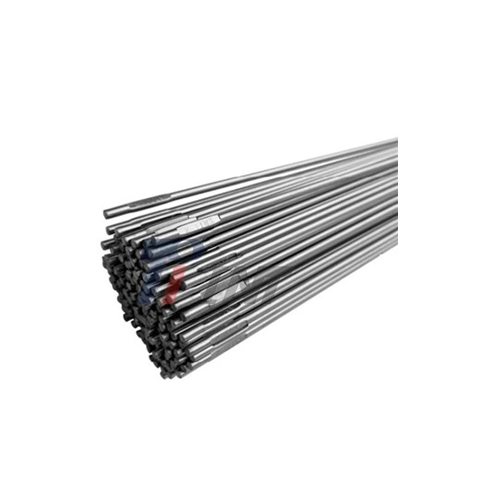
Baoji INT Medical Titanium Co., Ltd. has been selling medical-grade titanium materials since 2003. It was started by Mr. Zhan Wenge, who has worked in the business for more than 30 years. The wire we ship has a width of 0.8 mm to 6.0 mm and comes on a roll or in a straight length. We are certified by ISO 9001:2015, ISO 13485:2016, and the EU CE. Standard lead time is three to four weeks for regular orders, but shorter lead times are possible for repeat orders.
Conclusion
Picking the right ERTi titanium welding wire affects every step that follows, including the integrity of the joint, the duration of sterilization, the accuracy of the paperwork, and finally, the trust that your customers have in your product. ERTi-2 is best for welding a wide range of medical instruments, and ERTi-5 is best for welding high-strength structures. When you buy from a supplier that offers traceable MTCs, consistent surface quality, and flexible order quantities, you get rid of the friction that slows down instrument production lines. Baoji INT Medical Titanium Co., Ltd. keeps common grades and diameters in stock and has paperwork ready to help with export clearing and third-party checks.
FAQ
What is the difference between ERTi-2 and ERTi-5 wire?
ERTi-2 is a commercially available pure titanium that is very resistant to corrosion and easy to shape. It can be used for most instrument shaft welding. ERTi-5 (Ti-6Al-4V) delivers tensile strength of more than 825 MPa, which makes it good for high-stress structure parts. However, it is less flexible and reacts more strongly to heat when welding with ERTi titanium welding wire.
Why does my weld bead turn blue after welding titanium?
If the argon is blue or purple, it means that the protection isn't good enough. A bright silver bead is the only one that will do. Check for torch pollution, increase the flow of argon, and make sure the gas is at least 99.999% pure.
How should I store titanium welding wire?
Keep wire in a dry place by putting it in sealed plastic bags with desiccant. Titanium takes in hydrogen from water, which makes it porous and cracks welds.
What documentation should accompany each shipment?
Ask for a Mill Test Certificate (MTC) that follows EN 10204 3.1 and shows the heat number, chemical make-up, and mechanical test results. This document helps with both export customs clearance and the factory audit for your customer.
Can I weld titanium to stainless steel using ERTi wire?
It is not a good idea to weld titanium directly to steel because weak intermetallic phases form at the fusion zone. For metal structures that are not the same, you need either intermediate bonded layers or explosion-welded transition joints.
Request a Quote from Baoji INT Medical Titanium Co., Ltd.
Baoji INT Medical Titanium Co., Ltd. sells approved ERTi titanium welding wire to companies that make surgery instruments and need clear records, low prices, and regular monthly restocking. We can help with small orders of different grades and diameters because we are a direct supplier with ISO 13485:2016 and EU CE certification. To get a price or a sample of our material, email export@tiint.com or visit inttitanium.com right now.
References
1. American Welding Society. AWS A5.16/A5.16M: Specification for Titanium and Titanium Alloy Welding Electrodes and Rods. AWS, 2021.
2. ASTM International. ASTM B863: Standard Specification for Titanium and Titanium Alloy Wire. ASTM, 2020.
3. Donachie, Matthew J. Titanium: A Technical Guide. 2nd ed., ASM International, 2000.
4. Lutjering, Gerd, and James C. Williams. Titanium. 2nd ed., Springer, 2007.
5. European Committee for Standardization. EN 10204: Metallic Products — Types of Inspection Documents. CEN, 2004.
6. International Organization for Standardization. ISO 13485:2016 — Medical Devices: Quality Management Systems — Requirements for Regulatory Purposes. ISO, 2016.