




Why Titanium Bar for Medical Use Is Ideal for Implants and Instruments


 2026-10-14 08:53:14
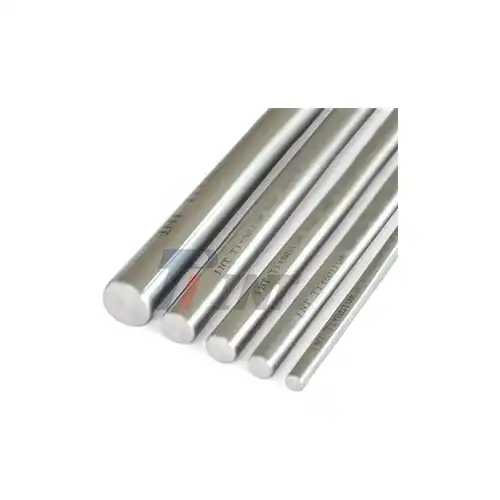
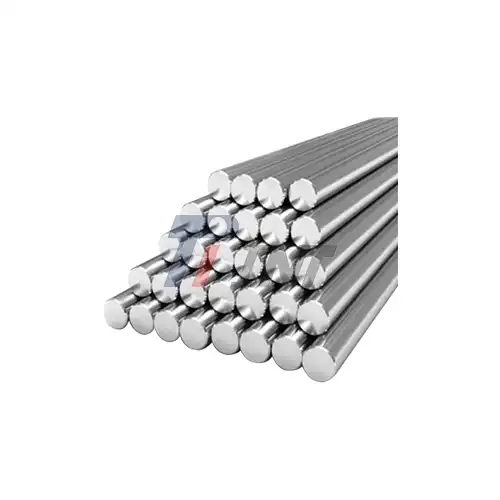
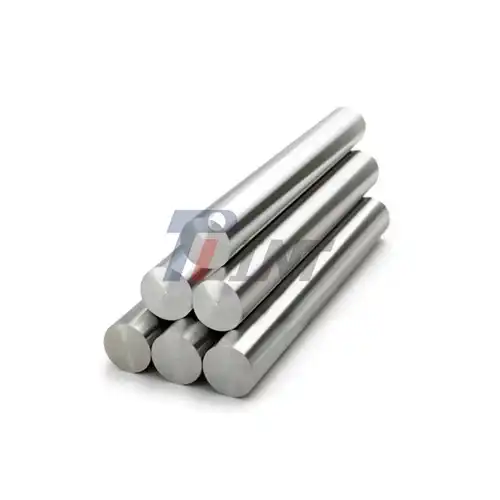
When manufacturers sourcing raw titanium stock ask why medical-grade titanium bar outperforms every competing material, the answer comes down to biology and physics working together. A titanium bar for medical use combines extraordinary biocompatibility, a high strength-to-weight ratio, and superior corrosion resistance into a single feedstock that surgical instrument workshops and implant machinists rely on daily. Whether you are machining forceps handles in Sialkot or turning spinal components in Solingen, the alloy grade you choose at the raw material stage dictates every quality outcome downstream.
|
|
|

What Makes Titanium Bars Suitable for Medical Applications
Medical-Grade Alloys and the Standards Behind Them
Medical grade titanium rods aren't all the same. Ti-6Al-4V (Grade 5) and Ti-6Al-4V ELI (Grade 23) are the two main alloys used to make surgical tools and implants. It has extra-low interstitial limits, with oxygen levels below 0.13 percent and iron levels below 0.25 percent. This makes it stronger and more flexible than normal Grade 5. Pure grades for business use (CP Gr1–Gr4) are still the best choice for instrument handles, shaft bodies, and working ends where shapeability and surface finish are more important than ultimate tensile strength.
ASTM F136 (Ti-6Al-4V ELI for surgery implants), ISO 5832-3, and the EN 10204 3.1 Mill Test Certificate that links each bar to a specific heat number are all compliance standards that a serious buying team must check. Clearance for exports and customer checks can't happen without that paper.
How Titanium Compares with Stainless Steel and Cobalt Chrome
Stainless steel is easy to work with and doesn't cost much, but its bulk (about 8.0 g/cm³) makes instrument sets heavier, and its modulus of elasticity (~200 GPa) is about twice that of cortical bone, which helps protect implants from stress. Cobalt-chrome alloys are harder, but the nickel in them makes some patients more likely to become sensitized. Titanium's stiffness (about 110 GPa) is more like human bone, which helps the implant fuse with the bone and keeps it from coming loose over time. Titanium's consistent machinability across CP and alloy grades makes planning tools and processes easier for shops that get orders of mixed grades.
Core Benefits That Drive Workshop Adoption
Knowing the technical benefits helps procurement managers explain to production bosses why the cost of the material is worth it. Here are the main reasons why titanium bar for medical use is the best material for instrument groups around the world:
Great biocompatibility: Ti-6Al-4V and Ti-6Al-4V ELI create a solid, self-renewing oxide layer that stops ions from entering nearby tissue. Clinical tests show that there is almost no cell death and very little chance of rejection, which is necessary for any part that will be used in a clean field or for long-term implantation.
- Excellent biocompatibility: Ti-6Al-4V and Ti-6Al-4V ELI form a stable, self-renewing oxide layer that prevents ion release into surrounding tissue. Clinical studies confirm negligible cytotoxicity and minimal rejection risk, which is mandatory for any component destined for the sterile field or long-term implantation.
- Lightweight and durable: At roughly 4.5 g/cm³, titanium weighs about 43 % less than stainless steel while maintaining an ultimate tensile strength exceeding 860 MPa (Grade 23). Instrument sets machined from titanium bar reduce surgeon fatigue during long procedures without sacrificing structural integrity.
- Corrosion resistance for long-term use: The passive TiO₂ surface film is self-repairing in chloride-rich physiological environments. Independent salt-spray and electrochemical testing consistently shows titanium outperforming 316L stainless steel under body-fluid simulation conditions.
- Exceptional fatigue resistance: Components such as bone screws, spinal rods, and instrument shaft bodies endure millions of load cycles. High fatigue resistance ensures these parts do not initiate micro-cracks under cyclic stress — a failure mode that has caused catastrophic outcomes with inferior materials.
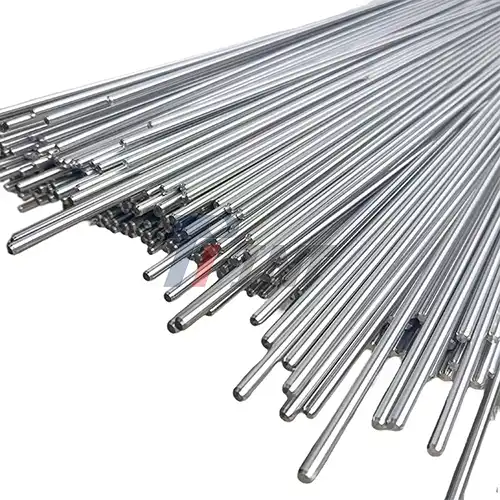
- Ease of fabrication: Centerless-ground bars held to ISO h8 or h7 diameter tolerance feed Swiss-type CNC lathes with consistent run-out accuracy, enabling intricate geometries on complex instrument profiles without tool chatter or diameter variation.
It's easy to make things because centerless-ground bars held to an ISO h8 or h7 diameter tolerance feed Swiss-type CNC lathes with constant run-out accuracy. This lets you make complex instrument profiles with complicated geometries without tool chatter or diameter variation.
Production and Quality Standards at a Reputable Manufacturer
From Melt to Certified Bar
The first step in making high-integrity medical titanium stock is vacuum arc remelting (VAR). This process gets rid of high-density inclusions and makes the microstructure of the billet uniform. After controlled thermomechanical forging and rolling, bars are put through ultrasound testing according to AMS 2631 Class A1 to find any cracks or holes inside that can't be seen from the outside. Before the bar is released, the grain size must be checked (ASTM E112 #5 or smaller) and the hydrogen, nitrogen, and oxygen amounts must meet the requirements through inert-gas fusion.
When materials are heated to high temperatures, a brittle, oxygen-rich layer called "alpha case" forms on the surface. This layer is checked for absence on every batch of titanium bar for medical use, because even a thin layer of alpha case can cause microcracks that shorten the life of finished implants.
Certifications That Procurement Teams Require
The Baoji INT Medical Titanium Co., Ltd. ships all of their goods with EU CE, ISO 13485:2016, and ISO 9001:2015 certifications. The Mill Test Certificate that comes with the product lists the heat number, chemical composition, mechanical test results, and the standard that applies (ASTM F136 / ISO 5832-3). This gives manufacturers further down the line the proof they need for export clearance and customer factory audits.
Procurement Guide: Selecting the Right Medical Titanium Bar Supplier
When buying titanium rod stock, there are more factors to consider than just the unit price. A trusted provider of titanium bars for medical use must meet a number of needs that small and medium-sized instrument makers often have at the same time:
The first filter is coverage of specifications. If you can find a seller that offers Gr1, Gr2, Gr4 CP grades along with Ti-6Al-4V ELI in diameters from 3 mm to 100 mm, you won't have to deal with as many vendors for your monthly orders. Flexible MOQ, which means accepting split orders of different grades in small batches, is a must for workshops whose monthly needs cover ten or more dimensions.
Lead time dependability is just as important as price. Standard dispatch within three to four weeks of order confirmation lets production planners keep monthly schedules that roll over without having to increase buffer stock. Another risk that isn't talked about enough is delayed material certificates. Documentation that comes after goods means either extra air-freight charges or packages that are held up, both of which cancel out any price advantage that was gained during negotiations.
Pricing that is linked to a verifiable alloy grade and mill origin of titanium bar for medical use lets purchasing managers compare prices from different suppliers without having to guess where costs were cut. It is common to ask for a 3.1 MTC along with a sample order before agreeing to a monthly supply, and any reputable maker will gladly do it.
Grade and Material Comparison: Matching Bar Specification to Application
CP Grades vs. Ti-6Al-4V ELI
CP Grades 1 and 2 are the most flexible and have the smoothest surface finish after polishing. They are perfect for instrument handles, shaft bodies, and working tips that are made by forging and then CNC and buffing. Grade 4 adds more strength while keeping the biocompatibility of CP, which makes it a good choice for tube parts with thinner walls.
Ti-6Al-4V ELI is the most common type of load-bearing implant stock used in spine rods, trauma fixation screws, and joint stem blanks. These parts must have a tensile strength of at least 860 MPa and be very difficult to break. If you choose the right grade when you're buying something, you can avoid material substitutions later on that could lead to regulatory non-conformance.
Conclusion
Medical-grade titanium bar for medical use is still the material of choice for implant machinists and companies that make surgery instruments because it meets the three main requirements for clinical hardware: it is biologically compatible, it is reliable mechanically, and it stays chemically stable over time. Material procurement can be turned from a cost line into a competitive edge by choosing stock that has full mill traceability, meets ASTM F136 or ISO 5832 standards, and comes with paperwork backed by ISO 13485. When workshops lock in a stable, approved supply partner, they cut down on rework, speed up customer audits, and protect export margins. These are the things that help the global surgical tool trade grow in a way that lasts.
FAQ
What is the difference between Grade 5 and Grade 23 titanium bar?
Grade 23 is like Grade 5 but with extra low interstitial. It sets stricter limits on the amount of oxygen and iron that can be in the material, which makes it more flexible and harder to break. Because of this, Grade 23 is usually used for implants that are likely to break, while Grade 5 is best for situations where power is more important than flexibility.
Which Mill Test Certificate format is required for export?
You must have an EN 10204 3.1 license. It needs to have a heat number, a chemical composition, mechanical test data, and a reference to ASTM F136 or ISO 5832-3 so that it can be used for both export clearance and audits by the end customer.
What diameter tolerances suit Swiss CNC machining?
It is best to use ISO h8 or h7 limit. Swiss-style lathes depend on guide bushings that need to be very consistent in diameter to keep the machine from vibrating and keep the workpiece centered during the machining cycle.
Can small mixed-grade orders be accommodated?
Yes, Baoji INT Medical Titanium Co., Ltd. does accept split orders across multiple grades and diameters. This makes monthly rolling procurement possible for workshops with different specification needs.
How is alpha case prevented in production?
Alpha case is removed using controlled atmosphere processing, and the structure is checked by looking at it under a microscope at 100x to 500x power on every production batch before it is sent out.
Request a Quote from Baoji INT Medical Titanium Co., Ltd.
From 2003 to now, Baoji INT Medical Titanium Co., Ltd. has sold certified medical titanium bar stock to companies on four continents. We can make titanium bars for medical use in a full range of diameters, from CP Gr1 to Gr4 and Ti-6Al-4V ELI. We offer a flexible minimum order quantity, shipping in 3–4 weeks, and full ISO 13485:2016 / EU CE paperwork with every package. To get samples, a detailed quote, or help choosing materials, email your list of requirements to export@tiint.com or go to inttitanium.com.
References
1. ASTM International. ASTM F136: Standard Specification for Wrought Titanium-6Aluminum-4Vanadium ELI Alloy for Surgical Implant Applications. ASTM International, 2023.
2. International Organization for Standardization. ISO 5832-3: Implants for Surgery — Metallic Materials — Part 3: Wrought Titanium 6-Aluminium 4-Vanadium Alloy. ISO, 2021.
3. Niinomi, M. "Mechanical biocompatibilities of titanium alloys for biomedical applications." Journal of the Mechanical Behavior of Biomedical Materials, 2008.
4. Long, M., & Rack, H. J. "Titanium alloys in total joint replacement — a materials science perspective." Biomaterials, 1998.
5. Geetha, M., Singh, A. K., Asokamani, R., & Gogia, A. K. "Ti based biomaterials, the ultimate choice for orthopaedic implants — a review." Progress in Materials Science, 2009.
6. International Organization for Standardization. ISO 13485:2016: Medical Devices — Quality Management Systems — Requirements for Regulatory Purposes. ISO, 2016.