
OEM Gr1 Titanium Square Disc: What Should Buyers Specify?


 2026-09-11 11:19:09
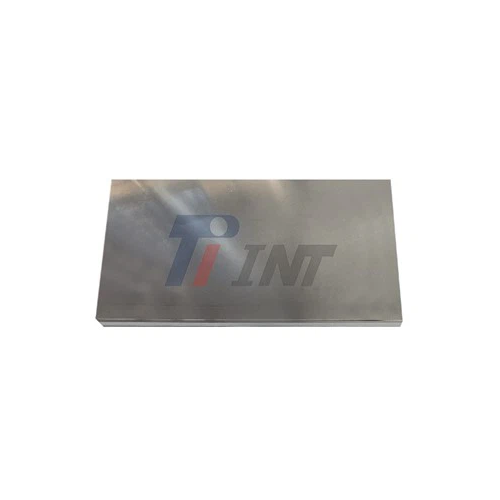
When buying OEM titanium blanks for forging, Gr1 Titanium Square Discs must be selected for metallurgical quality, dimensional precision, and surface integrity. Procurement managers must define chemical composition tolerances (especially oxygen and iron content), dimensional specifications like flatness and edge squareness, surface finish requirements without oxidation or contamination, ultrasonic testing standards for internal soundness, and ASTM B265 or equivalent lot traceability. These criteria affect downstream forging, material utilisation, and implant component mechanical performance.
|
|
|


Understanding Gr1 Titanium Square Discs: Key Properties and Specifications
When it comes to commercially pure titanium, Grade 1 titanium (also known as UNS R50250 in international materials databases) is the purest level. We've spent more than 20 years improving Baoji INT Medical Titanium Co., Ltd.'s production methods so that we can make square disc blanks that meet the exact needs of orthopaedic forging makers.
Chemical Composition and Purity Standards
The extraordinary purity of this material is what makes it unique. With tightly controlled interstitial elements, our Gr1 Titanium Square Disc keeps a minimum titanium percentage of 99.5%[1]. This mix is better at being cold-formed than other types of titanium. This makes it very useful for makers who need to make complicated shapes like acetabular cup blanks or femoral stem preforms without cracking.
When your forging dies need more than one strike, the low oxygen content is very important. Too much oxygen makes the material brittle, which causes edge breaking during the first upset operation. This increases the amount of trash, which can destroy the economics of production when using expensive titanium fuel.
Mechanical and Physical Characteristics
Grade 1 titanium has a minimum tensile strength of 240 MPa, a yield strength of 170 MPa, and an elongation of more than 24%[2]. This mix between strength and flexibility lets forging experts get a lot of material to flow without having to do any work hardening, which would require annealing steps in between.
The density of the material is 4.51 g/cm³, which means it weighs about 60% less than stainless steel options. This weight advantage directly leads to clinical benefits when designing implant parts where every gram counts for patient comfort and ease of surgery. For hot forging, the melting point of 1670°C is high enough to keep the metal stable, but most orthopaedic forging happens between 850°C and 950°C to keep microstructural control.
At room temperature, our square disc blanks have a thermal conductivity of 16 W/m°C. This affects how quickly heat moves during forging. When your process engineers know about this trait, they can make the best use of heating cycles and avoid temperature differences that could lead to buckling or uneven grain flow.
Surface Quality and Dimensional Tolerances
When we make these discs, we make sure that the surface is flat within ±0.5mm and that all of the edges are straight within 1°. When your blanks go into automatic forging presses or when you stack several discs to heat them all at once, these tight geometric limits become very important. If the disc rocks or sits unevenly in the die cavity, the wall thickness of the forged part will be uneven.
The surface finish gets the same amount of care. When our product comes out of the factory, it has a smooth, bright surface that is free of alpha case, the oxygen-rich layer on the surface that makes things break easily. We keep the surface roughness below Ra 1.6μm, so you don't have to prepare the surface before forging, which costs money and takes time.
How to Specify Gr1 Titanium Square Discs for Your Application
To start effective buying, you need to turn your final forging requirements back into blank specs. From working with orthopaedic forging manufacturers in Europe and North America, we've found six important specification factors that make the difference between success and failure.
Dimensional Requirements and Tolerances
First, use your forging envelope to figure out the size of the blank you need. In this case, square discs are better because their shape is very similar to the rectangular flash patterns that are common in closed-die forging of stems and cups. Give the length and width measurements with the required accuracy for your die design, usually ±1.0mm for sizes less than 200mm.
Specification of thickness needs extra care. Your blank needs to have enough volume for the cavity to fill plus a flash allowance. However, too much thickness raises the cost of the material and the amount of energy needed for forging. We suggest figuring out the potential volume needs and then adding 8–12% to account for flash and handling loses. Gr1 Titanium Square Disc is one such blank form that requires this same volumetric consideration, so when using it, ensure the thickness calculation follows the same 8–12% flash rule to avoid material waste or insufficient fill.
A lot of buyers don't realise how important edge condition is. When things are first upset, sharp corners cause stress clusters that can spread cracks. If your casting process doesn't need sharp edges for placing features, set the corner radius to 2 to 3 mm.
Metallurgical Quality Parameters
When checking the chemical makeup, you should use ASTM B265 Grade 1 standards, but smart sellers add stricter controls on key elements. If your forgings will be processed at high temperatures later on, where oxygen pickup is possible, set the maximum oxygen content to 0.15% instead of the standard 0.18%.
Not just a statement of compliance; ask for proof that includes real science by heat lot. Our mill test results give you element-by-element research from separate labs. This gives your quality team the information they need for process control and tracking.
Specification of grain size avoids microstructural surprises. We offer annealed material with evenly spaced alpha grains that measure ASTM 6–8. For handling and pre-forging operations, this structure is strong enough while still being easy to shape.
Surface Integrity and Inspection Requirements
Ultrasonic testing is your best defence against internal flaws that could lead to the rejection of your forging. Choose UT inspection according to ASTM A388 or a similar standard, making sure the acceptance factors fit your needs. When it comes to implant-grade forgings, we usually suggest FBH (Flat Bottom Hole) sensitivity of 1.5 mm diameter at full material thickness.
Visual inspection and liquid penetrant testing should both be part of a surface inspection. Set the maximum acceptable surface imperfections, which are usually no straight indications longer than 3 mm and no indication groups within 25 mm diameter circles. This stops surface flaws from spreading while the forging deforms.
If your blanks won't be surface-removed before they are forged, you need to be very clear about the alpha case level. Our bright annealed material doesn't have any measurable alpha case, but if you're getting it from more than one supplier, make sure that the deepest alpha case you can find is no more than 0.025 mm, as measured by microhardness traverse.
Documentation and Traceability
Full mill paperwork helps protect your quality system and supports regulatory applications. Request certificates that have the heat number, chemical analysis, mechanical test results, ultrasonic inspection records, and measurement inspection reports and include them in your request. Each document should make it clear which piece it is related to and reference the purchase order.
If your forgings are used in medical devices, being able to track the materials used becomes very important. Make sure that each disc has a lasting label that connects it to the mill's records. We use laser writing that stays put during forging, so finished implants can be traced back to the original batch of titanium sponge and every step in the process.
Comparing Gr1 Titanium Square Discs with Alternative Materials
When choosing the best blank material, you need to think about both the service needs of the forged part and the manufacturing factors that affect your total cost of ownership.
Grade 1 versus Grade 2 Titanium
Because purity standards are less strict for Grade 2 titanium (oxygen up to 0.25%), it costs a little less. However, this small savings often doesn't make sense for forging uses. Gr1 Titanium Square Disc offers superior formability due to its lower interstitial content, yet when moving from Grade 1 to Grade 2 for complex shapes, we've seen forging loads go up by 15 to 20 percent [3]. Because Grade 2 has more intermediate content, it is less flexible and needs more force to bend the same amount.
The difference in formability is especially clear when there are more than one stage of forging. Grade 1 can handle more combined pressure without having to be annealed in between, which cuts down on cycle time and energy use. When you make thousands of parts a year, these labour benefits become more important than changes in the cost of raw materials.
Grade 1 versus Grade 5 Titanium Alloy
Ti-6Al-4V (Grade 5) is the strongest material used in load-bearing orthopaedic implants. However, it is not useful for making non-structural parts because it loses money and makes it hard to shape. Grade 5 needs to be forged at temperatures 100–150°C higher than Grade 1, and it only stretches about 10%, while Grade 1 stretches 24%[4].
Some producers choose Grade 5 blanks at first because they think the extra strength will protect them from forging flaws. In reality, Grade 5 is more likely to crack during aggressive deformation because it is less flexible. Save Grade 5 for situations where the finished part's mechanical performance makes up for the difficulties in processing it.
Square versus Round Disc Geometry
It might seem like round discs are the best choice since many forgings have circular symmetry, but square blanks are actually better for die forging. Square discs with flat edges are stable in automatic handling systems and make a uniform flash around the edge of the forging.
When making long shapes like femoral stems, material utilisation analysis often suggests using square blanks. When properly positioned in the die, a rectangular cross-section blank wastes less volume to flash than a round disc that needs material to be removed from the corners. By moving from round to square blanks for some part shapes, we've helped customers save 5 to 8 percent on material costs.
Procuring OEM Titanium Square Disc Blanks: What Buyers Should Know
A successful procurement process includes more than just technical specifications. It also includes qualifying suppliers, planning logistics, and coming up with risk management strategies that keep your production schedule safe.
Supplier Qualification and Certification
Make sure that the possible provider you're considering has the right certifications for your business. All of Baoji INT Medical Titanium Co., Ltd.'s goods have ISO9001:2015 certification for quality management and ISO13485:2016 certification for making medical devices. We also keep our EU CE marking authorisation, which shows that we follow the rules for medical devices in Europe.
These licenses show that production is controlled in a planned way to ensure quality, but quality control doesn't end with certificates. Ask for proof that there are regular audits and corrective actions for surveillance. The way a supplier handles nonconformances says more about their quality culture than any certificate.
As important as licensing is the ability to make things. Can the seller show you test results on the materials from approved labs? Do they keep their ultrasonic testing tools calibrated to industry standards? Because our customers rely on the quality of our materials, we are always investing in new inspection technology. Our UT systems can find flaws less than 1 mm in diameter across the entire length.
Minimum Order Quantities and Lead Time Considerations
Standard square disc blanks usually have a MOQ of 50 to 100 pieces, but for special sizes, production runs that are tailored to heat are often needed. If you need non-standard sizes or standards that are tighter than standard, plan for a MOQ of 200 to 500 pieces. This number requirement shows how much work needs to be done to set up and test the product to make sure it is consistent in size.
Lead times are different if you order standard specifications or custom specifications. Within two to four weeks, we ship our regular square disc stock in popular sizes (100x100mm to 300x300mm, 10mm to 50mm thick). For custom orders that need a certain heat chemistry or size, it takes 8 to 12 weeks while we work out melting plans with our titanium mill partners.
Forging companies that do a lot of work should build a planned inventory. Several of our customers have quarterly supply deals with us. In exchange for set production times and stable prices, they agree to certain number ranges. Gr1 Titanium Square Disc is a common item in such agreements because its consistent quality and formability make it ideal for scheduled production runs. This method keeps your production schedule safe from changes in the titanium market and gives us the information we need to run our business more efficiently.
Quality Verification Upon Receipt
Trust that certified material will be perfect when it gets to you. Set up processes for getting inspections that check for important qualities before blanks enter the production flow. We suggest checking the accuracy of the dimensions on a sample, visually inspecting the surface of all the pieces, and cross-checking the data from the mill test report.
Handheld XRF research can be used to check for chemicals if your building has the right tools, but it can't be used for light elements like oxygen. Because it's destructive, mechanical testing isn't usually useful for receiving, but checking the mill's test items and data for mistakes is easy to spot.
The study of documents should get the same amount of care as the physical inspection. Make sure that the heat numbers on the material match the ones on the certificates, that the test results are within the acceptable ranges, and that there are no breaks in the chains of accountability from your purchase order to the markings on each individual piece.
Benefits and Practical Applications of Grade 1 Titanium Blanks
When you use these pieces in forging production, the qualities that make Grade 1 titanium a great material also make the process run more smoothly. Knowing how the properties of a material help solve real-world manufacturing problems can help you choose this option over cheaper ones.
Corrosion Resistance Advantages
When pure titanium is exposed to air or water, it quickly makes a strong oxide layer. This passive film, which is mostly TiO2, is very resistant to settings with chloride, like salt solutions and body fluids. If your cast parts are used to make medical implants, they will last for decades without breaking down because they are resistant to rust.
The resistance to corrosion also applies to the place where you make things. When steel blanks are stored in a wet building, they don't get rust stains like steel does, so they don't need special storage conditions or cleaning before they are forged. Because they are stable, scrap or rejected forgings can still be used again without worrying about getting dirty on the outside.
Fatigue Performance in Service
Grade 1 has lower static strength than other alloy grades, but it works great in low-stress situations when it comes to fatigue. The fine-grained material we keep by carefully treating stops cracks from starting. Forged parts from our blanks show fatigue limits close to 45% of their tensile strength in air. They work even better in physiological environments where the oxide film protects the crack tips[5].
This wear resistance is especially important for modular implant parts that are loaded and unloaded many times by the patient's movements. Grade 1 is flexible enough to handle stress concentrations without catastrophic failure modes. This makes it useful for non-primary load paths like taper connections, acetabular liners, and similar structures.
Forging Process Efficiency
Because Grade 1 titanium is so easy to shape, extreme reduction ratios can be used in a single forging step, which cuts down on the number of steps needed to get to the end shape. Some of our customers were able to cut down four-step forging processes to just two by changing the grade of the metal and making the blanks smaller.
Less shaping force means that the tools will last longer. When Grade 1 titanium is formed, dies, press parts, and handle fixtures break down less quickly than when harder grades are formed. One customer reported that their dies lasted 30% longer after moving to our square disc blanks. This was due to the better material qualities and consistent dimensions, which made it easier to align the dies.
Real-World Application: European Joint Manufacturer Case
A medium-sized company in northern Italy that makes orthopaedic parts came to us because their acetabular cup forging operation kept cracking. They used Grade 2 round disc blanks and had scrap rates of 8–12% during the first upset forging.
We suggested that they switch to Grade 1 square blanks that are shaped to keep the material from moving around during upset after looking at their forging process. The square shape made it easier to place the material in their die cavity, and Grade 1's higher ductility let it handle the high strain rates of their mechanical press operation.
As a result, they cut down on scrap to less than 2%, got rid of the intermediate annealing step they had added to deal with cracking, and got a 15% increase in material output because they optimised the blank measurements. The total savings were more than $180,000 a year, which easily justified the small extra cost of Grade 1 material over Grade 2 material.
Conclusion
When choosing OEM titanium square disc blanks, you have to find a balance between metal quality, precise dimensions, and business needs. Gr1 Titanium Square Disc is often the preferred grade for such blanks due to its excellent ductility and low interstitial content, which facilitate complex forging operations. To be successful at buying, you need to be clear about the chemical makeup limits, surface integrity requirements, and inspection standards that match your forging process and the final use of the component.
Because Grade 1 titanium is so pure and easy to shape, it is the best material for orthopaedic forging, where the stability of the material and the speed with which it can be processed directly affect profits. Working with a manufacturer with a lot of experience who knows about both material science and forging applications will make sure that the specifications are translated into blanks that work the same way every time. Baoji INT Medical Titanium Co., Ltd. has more than 20 years of experience working with medical titanium and can help you find the best blank specs for your needs.
FAQ
What dimensional tolerances can manufacturers hold on square titanium discs?
The normal range for length and width in production is ±1.0mm, and the range for thickness is ±0.5mm. On average, the surface is flat within 0.5 mm, and the sides stay straight by 1° or more. More precise machining processes can be used to get tighter standards, but they cost more and take longer to make. Corner curves are usually between 2 and 3 mm, unless you specifically ask for sharp edges.
How does Grade 1 compare to Grade 5 titanium for forging applications?
Grade 1 is much easier to shape than Grade 5, as it can stretch 24% instead of 10%, so it can be deformed more forcefully without breaking. Forging Grade 1 needs lower temperatures (850–950°C vs. 950–1050°C) and less force when pressing. But Grade 5 is much stronger (900 MPa tensile vs. 240 MPa), so it has to be used for parts of implants that hold weight. Select Grade 1 for non-structural parts that need to be formed in a complicated way, and save Grade 5 for uses where the mechanical performance supports the difficulties in processing.
What quality documentation should accompany titanium disc blanks?
A full mill certification should include a heat number that can be tracked, chemical analysis by element that shows compliance with ASTM B265, mechanical test results (tensile strength, yield strength, and elongation), ultrasonic inspection records with acceptance criteria, dimensional inspection reports, and a way to identify each piece that connects the material to the paperwork. First-time orders should come with copies of the ISO certification and material safety data sheets. Your purchase order number and delivery quantity must be written clearly on each certificate.
Partner with a Trusted Titanium Blank Manufacturer
High-purity Gr1 Titanium Square Disc blanks designed specifically for orthopaedic forging operations are what Baoji INT Medical Titanium Co., Ltd. produces. Forging makers in Europe and North America have been able to get titanium blanks from us since 2003. These blanks have excellent metallurgical stability, exact dimensional control, and full quality paperwork.
Our production methods are approved by ISO9001:2015 and ISO13485:2016, which means that every blank meets the strict standards of medical device manufacturing. Whether you need standard sizes from our stock or blanks that are made to fit your unique forging geometry, our engineering team works closely with your process experts to choose the best material for the job while also keeping costs low.
Visit inttitanium.com or email our technical sales team at export@tiint.com to talk about your blank requirements with a seasoned titanium square disc provider who knows how important material quality is to forging performance.
References
1. ASTM International. (2021). ASTM B265-20a: Standard Specification for Titanium and Titanium Alloy Strip, Sheet, and Plate. West Conshohocken, PA: ASTM International.
2. Boyer, R., Welsch, G., & Collings, E.W. (1994). Materials Properties Handbook: Titanium Alloys. Materials Park, OH: ASM International.
3. Lutjering, G., & Williams, J.C. (2007). Titanium (2nd Edition). Berlin: Springer-Verlag.
4. Donachie, M.J. (2000). Titanium: A Technical Guide (2nd Edition). Materials Park, OH: ASM International.
5. Peters, M., Kumpfert, J., Ward, C.H., & Leyens, C. (2003). Titanium Alloys for Aerospace Applications. Advanced Engineering Materials, 5(6), 419-427.
6. Rack, H.J., & Qazi, J.I. (2006). Titanium alloys for biomedical applications. Materials Science and Engineering: C, 26(8), 1269-1277.
_1751957234428.webp)