
ASTM F136 Titanium Round Bar vs Grade 5: Which Is Best for Implants?


 2026-10-13 09:19:58
When implant manufacturers evaluate raw titanium materials, the choice between an ASTM F136 titanium round bar and a standard Grade 5 bar carries real regulatory and clinical weight. The short answer: for long-term surgical implants, ASTM F136 is the superior choice. Its Extra Low Interstitial (ELI) chemistry, tighter interstitial element controls, and implant-specific certification make it the benchmark material for orthopedic, spinal, and craniofacial applications. Grade 5 serves well in industrial and aerospace contexts but does not consistently meet the biocompatibility thresholds demanded by FDA and MDR registration pathways.
|
|
|

Understanding ASTM F136 and Grade 5 Titanium Round Bars
The science of both materials is Ti-6Al-4V, but there is a big difference between them that is clinically important when you look at what the "ELI" name really means.
Chemical Composition: Where the Difference Is Made
It is capped by ASTM F136 at 0.13% for oxygen, 0.25% for iron, and 0.08% for carbon. Standard Grade 5 (ASTM B348) lets up to 0.20% air and 0.30% iron through. Those numbers gaps that don't seem very big have a direct effect on flexibility and crack toughness. High interstitial oxygen levels cause microstructural embrittlement, which is a problem when an implant has to deal with the changing physiological loads it faces over many years. The stricter chemistry of ASTM F136 keeps the alpha-beta phase balance and stops microscopic cracks from spreading, which can cause the device to break.
Mechanical Properties at a Glance
ASTM F136 has a minimum tensile strength of 860 MPa (125 ksi), a minimum yield strength of 795 MPa (115 ksi), and a minimum stretch of 10%. Its modulus of elasticity is close to 110 GPa, which is about half of what stainless steel and cobalt-chrome have. This makes it less effective at protecting against stress and stops bone loss around prosthetics. Grade 5 can match or slightly beat tensile strength numbers, but because it has more interstitial content, it doesn't stretch as much. This makes it stiffer, which isn't good in a biological load-sharing environment.
Head-to-Head Comparison: ASTM F136 vs Grade 5 for Implants
To figure out which bar works better in an industrial and regulatory setting, you need to look at both compliance factors and raw mechanical data.
Biocompatibility and Regulatory Standing
The FDA's guidelines papers and the EU's Medical Device Regulation (MDR) both list ASTM F136 titanium round bar as a material that can be used for implants. A lot of European registered bodies agree that ISO 5832-3 is very similar to F136. Grade 5 titanium made according to ASTM B348 does not have a similar implant-specific name. When Grade 5 is used without more biocompatibility bridge data under ISO 10993, regulatory affairs teams often get pushback during technical file reviews. By choosing F136, you get rid of that paperwork right away.
Fatigue Life and Corrosion Resistance in Physiological Conditions
That's right, the saline environment inside our bodies is hostile. Because ASTM F136 has a controlled microstructure and a low iron content, it is better at resisting crevice corrosion and galvanic attack. This is especially important in dental and orthopedic settings where the pH level changes. According to ASTM F1801 fatigue tests, F136 regularly does better than standard Grade 5 under high-cycle loading. This is important for hip stems and spinal rods that are used every day and are loaded and unloaded millions of times. When used in static or low-cycle situations, Grade 5 works fine, but it can't handle the dynamic stresses that come with implantable devices as well.
Machinability and Workshop Considerations
Both grades work well on CNC milling and turning platforms, but because F136 is more flexible, the cutting settings need to be slightly changed to control chip formation. Standard delivery format for implant machining lines is centerless-ground or peeled F136 bar stock with a h8/h9 diameter error. This makes sure that tools last the same amount of time and that measurements are always the same from batch to batch. When making precise spinal screws or femoral stems to tight drawings, Grade 5 bar with wider tolerances leads to more scrap.
Procurement Insights: Sourcing Implant-Grade Titanium Bar
When budgets are tight and rules need to be followed, procurement teams need more than just a material proof. They need a supply chain that they can check and trust.
Here are the main forms of identification and qualifications needed to buy implant-grade titanium:
- EN 10204 3.1 Mill Certificate tied to a traceable heat number, covering full chemical composition and mechanical test results from the producing mill.
- Third-party test reports confirming ASTM F136 compliance for chemistry, microstructure (ASTM E112 grain size), and mechanical properties — essential for FDA 510(k) and CE MDR technical files.
- ISO 13485:2016 quality management system certification at the supplier level, with readiness to support customer source inspections or video audits.
- Flexible minimum order quantities to support new implant development sampling alongside volume production runs.
Most orthopedic OEMs will not budge on these requirements. Your product registration timeline will be slowed down if your supplier can't provide heat-traceable documentation within days of being asked to do so. Traceability gaps are much smaller when you work with a vertically integrated producer of ASTM F136 titanium round bar that oversees the whole production process, from the ingot melt to the polished bar.
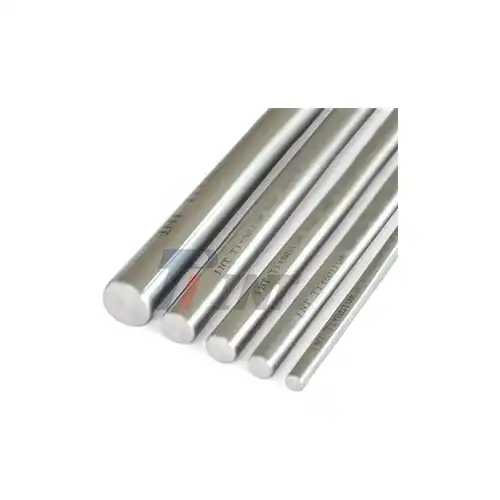
During the design and development phase, when engineers need multiple specifications with full certification before committing to volume, suppliers who offer centerless-ground ASTM F136 bar in diameters from 3 mm to 150 mm with short sampling lead times are very helpful.
Application Focus: Why ASTM F136 Is Preferred in Surgical Implants
The ELI designation wasn't made up on the spot. It came about because of decades of clinical data that showed how controlling interstitial elements affected how long devices lasted and how well patients did.
Orthopedic and Spinal Applications
In hip repair, femur stems made from F136 bar have to be able to handle cyclic loads of more than 500 N for millions of cycles without starting to crack. Because of its high wear limit and high damage tolerance, which are both direct results of the ELI chemistry, the material is the usual choice. For spine rods, the ductility advantage is useful because doctors can shape rods during surgery to fit the patient's body. It would be very bad for the surgery if the rod broke while it was being bent. The elongation ceiling in F136 protects against that situation in a way that standard Grade 5 can't.
Craniofacial and Thoracic Fixation
Craniofacial plates and thoracic fixation parts work in areas with complicated anatomy, where thinner cross-sections have to handle a range of loads. Because it has a high strength-to-weight ratio and doesn't rust in a tissue environment that is always changing, ASTM F136 is also the best base material for these uses.
How to Choose the Right Titanium Round Bar for Your Implant Projects
There are three main things that affect the choice of material: the legal road you are taking, the mechanical needs of the implant design, and the dependability of the ASTM F136 titanium round bar supply chain you need.
If your device is for the U.S. FDA or EU MDR markets and will be implanted for a long time, ASTM F136 is the only baseline material that can be defended. Any cost savings from using the non-ELI grade are usually outweighed by the extra paperwork needed for regulatory purposes when Grade 5 is used instead. This includes extra ISO 10993 biocompatibility testing and possible notified body queries. Grade 5 is still good for surgical instruments that don't stay in the body, external fixation parts that don't stay in the body, and prototype development where the final choice of material hasn't been made yet.
For large-scale production, work with an ASTM F136 titanium round bar maker that keeps a collection of different diameters, offers flexible sampling programs, and provides proactive, not reactive, batch-to-batch paperwork.
Conclusion
The ASTM F136 titanium round bar is designed to be used in the production of implants. Its ELI chemistry, alpha-beta microstructure, non-magnetic qualities that are safe for MRIs, and strong regulatory history give implant OEMs the compliance and mechanical performance they need. Grade 5 titanium is a good material for engineering, but it wasn't made to be used permanently inside living things. Also, the lack of paperwork makes it a pricey option in controlled markets. When it comes to making implants, F136 is the clear choice when patient safety and legal speed are the most important things.
FAQ
Is ASTM F136 the same as Ti-6Al-4V ELI?
In fact, ASTM F136 is the standard for cast Ti-6Al-4V ELI metal that is meant to be used in medical implants. The ELI name means that the interstitial elements (oxygen, nitrogen, hydrogen, and iron) are held to lower maximums than in normal Grade 5. This makes the steel more flexible and less likely to break.
What certifications should an ASTM F136 bar supplier provide?
You should ask for an EN 10204 3.1 mill certificate with a heat number, a chemistry and mechanical test report from a third party, ISO 13485:2016 certification, and biocompatibility supporting documents. A second level of quality management is provided by suppliers who work under both ISO 9001:2015 and ISO 13485.
Can ASTM F136 bar be welded?
Yes. It's easier to weld than standard Grade 5 because it has less oxygen in it. All welding must be done in a neutral argon atmosphere to keep the heat-affected zone from becoming weakened by air pollution.
What diameters are typically available?
Implant makers often get centerless-ground F136 bar with a width of 3 mm to 150 mm. For CNC machines that need consistent input dimensions, tolerance classes h8 and h9 are standard.
Is Grade 5 ever acceptable for implant applications?
If you don't need full implant-grade approval for certain exterior or short-term contact uses, Grade 5 can be used. ASTM F136 is the standard and acceptable material for fixed load-bearing implants that are regulated by the FDA or the MDR.
Partner With Baoji INT Medical Titanium Co., Ltd. for Certified F136 Bar
Since 2003, Baoji INT Medical Titanium Co., Ltd. has been providing implant-grade titanium materials. They are certified by the EU under ISO 13485:2016 and ISO 9001:2015. Our company is a reliable source for ASTM F136 titanium round bars. We offer full heat traceability, EN 10204 3.1 certificates, and flexible sample plans for diameters ranging from 3 mm to 150 mm. You can visit inttitanium.com or email our technical team at export@tiint.com to get a price, talk to an expert, or get our product datasheet.
References
1. ASTM International. ASTM F136: Standard Specification for Wrought Titanium-6Aluminum-4Vanadium ELI Alloy for Surgical Implant Applications. ASTM International, 2013.
2. Black, Jonathan, and Garth Hastings. Handbook of Biomaterial Properties. Springer, 1998.
3. Rack, H.J., and J.I. Qazi. "Titanium Alloys for Biomedical Applications." Materials Science and Engineering: C, 2006.
4. ISO. ISO 5832-3: Implants for Surgery — Metallic Materials — Part 3: Wrought Titanium 6-Aluminium 4-Vanadium Alloy. International Organization for Standardization, 2021.
5. Niinomi, Mitsuo. "Mechanical Biocompatibilities of Titanium Alloys for Biomedical Applications." Journal of the Mechanical Behavior of Biomedical Materials, 2008.
6. Donachie, Matthew J. Titanium: A Technical Guide. 2nd ed., ASM International, 2000.
_1755062427525.png)
_1752463990252.webp)
_1752462435099.webp)
_1751956867796.webp)